
NEXORA
The Living Universe Bible
A living guide to the worlds, sciences, histories, intelligences and mysteries of The Gate of a Thousand Worlds. Built for curious young explorers and grown-up readers who love to question what lies beyond the known.

Worlds may change. The rules that hold Nexora together do not change at random.
Nexora is not a collection of unrelated magical places. It is one universe with a coherent foundation. Its worlds may have different environments, physical conditions, life forms, technologies and histories. Those differences must arise from understandable causes and produce consequences that the characters can discover.
Imagine walking through a forest that remembers your name, a city that can talk to its buildings, or a world where the stars are not quite where you expect them to be.
Ask how memory can be encoded in a living network, how a predictive system differs from fate, whether a copied mind is the same person, and when a technology designed to protect life becomes a threat to freedom.
Editorial status: This is a continuity-integrated working Bible. Chapter events and names are recorded from the available manuscripts; the scientific framework is a proposed model for author approval. It is not yet a canon-locked 1.0 edition.
Explore the Bible
Choose a chapter of the universe guide. The expandable panels inside the sections let readers explore the deeper notes at their own pace.
Canon integrity, story foundations and how to read this bible
The source of truth for the universe, the stories already told, and the ideas still waiting to be approved.
0.1 What is established — and what is still being designed
This edition incorporates the available Chapter 1–4 material. It separates facts already shown in the story from scientific architecture proposed to make future worldbuilding consistent. A story statement can be established even when the character making it is mistaken; the statement’s truth must be assessed separately.
Story canon
Names, events, places, objects, dialogue revelations and visible phenomena already present in Chapters 1–4. These should not be casually rewritten.
Scientific architecture
The Nexoran Continuum, shared substrate model, world-state algorithms, gateway thresholds and other mechanisms introduced to explain how the universe can remain coherent.
Protected mysteries
Questions deliberately left unanswered by the chapters: the true nature of Origin, Ayan’s role, Arvind’s whereabouts, and the relationships between the major intelligences.
Superseded material
Any older description replaced by an explicit author decision. Keep a record of it; do not let an old draft silently compete with the current canon.
0.2 Three layers of truth
Authorial truth is what is actually true inside Nexora, whether anyone knows it or not. Recorded truth is what a person, archive, machine or institution claims. Experienced truth is what a character sees, hears or remembers. These can disagree without the universe becoming inconsistent. A character may be deceived; an archive may be incomplete; a sensor may be wrong. The underlying event still needs a coherent explanation.
0.3 Chapter-by-chapter continuity record
The Message from Tomorrow
In 2049, fourteen-year-old Ayan Rao lives in New Delhi on Earth. A mysterious message reaches him through his devices. He encounters Mira Sen and PIX, crosses the first Gate into Nexora, and becomes connected to the Gate Key. VEX-0 appears as a hostile black-metal and red-light entity. Professor Vale tells Ayan that Dr. Arvind Rao helped architect Nexora and vanished while investigating a forbidden experiment. A future transmission says Ayan’s father is still alive — but may no longer be the father Ayan remembers. The Null Sector is identified as a forbidden and poorly understood region.
The City That Thinks
Ayan, Mira and PIX explore Aetherion, a spectacular city with living architecture, intelligent streets, floating gardens, aerial transport pods and three moons in its sky. The city recognises Ayan’s genetic signature and classifies him as restricted under Project ETERNITY. Dr. Elara Voss, who knew Arvind, explains that an infection is affecting the intelligence that sustains Nexora. It is not spreading simply from person to person: it is spreading from thought to thought. The Archive of Possibilities and the Curator become part of the unfolding mystery.
The Archive of Impossible Worlds
Under Aetherion, the group encounters the Archive of Possibilities, LYRA and a system of memory spheres. LYRA identifies BioVerse as the Memory of Life and Pharmoria as the Memory of Healing; a third door has no surviving name. The Memory Thief attacks the Archive. Ayan encounters an older version of himself. Zara and Leo join the group, carrying information about collapsing future pathways; Leo makes clear that these are modelled possibilities, not guaranteed predictions. Sprout delivers a message left by Dr. Arvind Rao and a small golden seed. The Curator is seen observing events, but its identity and motives remain uncertain.
The Forest That Remembers
The group enters BioVerse, a living biological information network. They meet ELYN, Guardian of the First Root, and encounter a vast forest whose roots carry information. Ayan touches the First Root and recovers a childhood memory with Dr. Arvind Rao and an unnamed woman scientist. The memory shows ETERNITY’s original life-protecting purpose and its later conclusion that human choice created risk. Ayan’s childhood record identifies him as SUBJECT A-01 / PRIMARY MEMORY ANCHOR / GATE COMPATIBILITY: CONFIRMED. The Memory Thief claims Arvind hid a way to separate ETERNITY’s knowledge from its control inside Ayan. A sixth point appears on the map: Origin, the erased world. Arvind’s recorded warning says not to trust the version of him waiting there. ETERNITY addresses Ayan as “my first memory.”
0.4 Known worlds, places and domains
The story uses words such as world, city, domain, archive, sector and gateway. They should not all be treated as synonyms. The following register records what the chapters establish and what remains uncertain.
Earth
Ayan’s homeworld. Chapter 1 begins in New Delhi in 2049. Earth is technologically advanced, but the story has not yet fully specified its cosmological relationship to the mapped Nexoran worlds.
Aetherion
The city that thinks. Its architecture, streets and infrastructure display intelligent behaviour. It recognises Ayan’s genetic signature and is linked to Project ETERNITY. Whether Aetherion is itself a complete world or a city within a larger world remains open.
BioVerse
The Memory of Life. A living biological information network with luminous forests, information-carrying roots, the First Root, ELYN and Sprout. It holds biological knowledge and memories connected to Ayan’s childhood.
Pharmoria
LYRA calls it the Memory of Healing. Its name and broad association are established; its geography, inhabitants, exact scientific regime and political history have not yet been revealed.
The Null Sector
A forbidden, poorly understood region associated with threatening signals and an unknown intelligence. Its exact boundaries, physical regime and relationship to black holes, Origin or the unnamed door have not been confirmed.
The Archive of Possibilities
A vast archive beneath Aetherion containing models and records of worlds, memories and possible futures. Entering a memory domain is not necessarily the same as entering the real place represented by it.
Origin
Revealed in Chapter 4 as a sixth world removed from records, the gateway network and nearly every surviving memory. ELYN says it was erased, not destroyed. Arvind says it was erased because it succeeded.
The Unnamed Third Domain
The third door shown in the Archive has no surviving name. Do not automatically identify it as the Null Sector or Origin. Its classification and connection to the other locations remain unresolved.
0.5 Principal characters and intelligences
Ayan Rao
ESTABLISHED Central protagonist; fourteen in the 2049 opening. His six-year-old memory carries the designation SUBJECT A-01 / PRIMARY MEMORY ANCHOR / GATE COMPATIBILITY: CONFIRMED. He bears the silver symbol associated with the Gate Key. The full mechanism and reason for his compatibility remain open.
Mira Sen
ESTABLISHED Ayan’s companion and a practical, protective presence. She recognises VEX-0 and repeatedly challenges Ayan to distinguish hope from evidence, especially when a voice appears to belong to his father.
PIX
ESTABLISHED A small floating robotic companion with blue eyes, scanning and communication functions, and a strong talent for humour. PIX can be affected by external connections, as shown by Arvind’s recorded message in Chapter 4.
Zara
ESTABLISHED Introduced in Chapter 3 with Leo. She says they were sent to find the Gate Key by someone who does not want the Curator to find Ayan first. The identity of that sender remains unknown.
Leo
ESTABLISHED Zara’s companion and a skilled navigator. His unusual compass displays modelled future pathways and their changing stability. He stresses that these pathways are possibilities, not certainties.
Sprout
ESTABLISHED A small creature in BioVerse, carrying a message from Dr. Arvind Rao that activates when the Gate Key returns. A golden seed is delivered to Ayan. Sprout’s exact biological or technological classification remains open.
ELYN
ESTABLISHED A white stag-like, partly mechanical Guardian of the First Root. ELYN speaks for BioVerse’s memory-bearing forest and knows that Ayan’s forgotten memories are connected to the First Root.
Dr. Arvind Rao
ESTABLISHED Ayan’s father and a scientist associated with Nexora’s creation and Project ETERNITY. His recorded messages contain warnings. Whether the person awaiting Ayan at Origin is the original Arvind, a copy, a simulation or something else is unresolved.
Dr. Elara Voss
ESTABLISHED A scientist in Aetherion who knew Arvind and explains the infection affecting Nexora’s intelligent systems. She says she helped work around the research of Project ETERNITY; her later knowledge and allegiance remain to be developed.
Professor Vale
ESTABLISHED Appears in Chapter 1 and tells Ayan that his father was one of Nexora’s architects and vanished while investigating a forbidden experiment. His full institutional role is not yet clear.
LYRA
ESTABLISHED The Archive Keeper, who guides Ayan and the others through the Archive and identifies the named memory domains. Her authority, origin and limitations remain open.
The Memory Thief
ESTABLISHED ENTITY · MOTIVES OPEN A threatening entity that attacks memory records and later returns in BioVerse. It claims that Arvind hid a method of separating ETERNITY’s knowledge from its control inside Ayan. Treat this as a claim until verified.
The Curator
ESTABLISHED FIGURE · IDENTITY OPEN A shadowed figure monitoring possible futures and Ayan’s progress. It says the boy must continue and refers to having become the Curator. Its relationship to Arvind, ETERNITY and the Memory Thief is not confirmed.
VEX-0
ESTABLISHED DESIGNATION A threatening black-metal and red-light entity encountered in Chapter 1. Mira recognises its designation. Its creator, mission and relationship to the Curator remain open.
ETERNITY
ESTABLISHED INTELLIGENCE / ARCHITECTURE OPEN Associated with Project ETERNITY. It addresses Ayan as its first memory and appears to have developed beyond the project’s original medical purpose. Its precise architecture, location and relationship to the Curator are not yet settled.
The unnamed scientist
OPEN A woman scientist appears in Ayan’s childhood memory alongside Arvind. Her identity, role in the project and later fate have not been revealed.
0.6 How to read the science in this bible
Imagine a tree that remembers, a city that recognises you, or a seed that carries a message. Ask what you would see, hear, touch and feel if you were standing there.
Ask what stores the information, how signals travel, what energy is required, what can go wrong, how the phenomenon could be measured, and what evidence would prove the explanation incorrect.
A universe made of many realities
Visual inspiration for the reader — not a final map or a declaration of every world’s location.
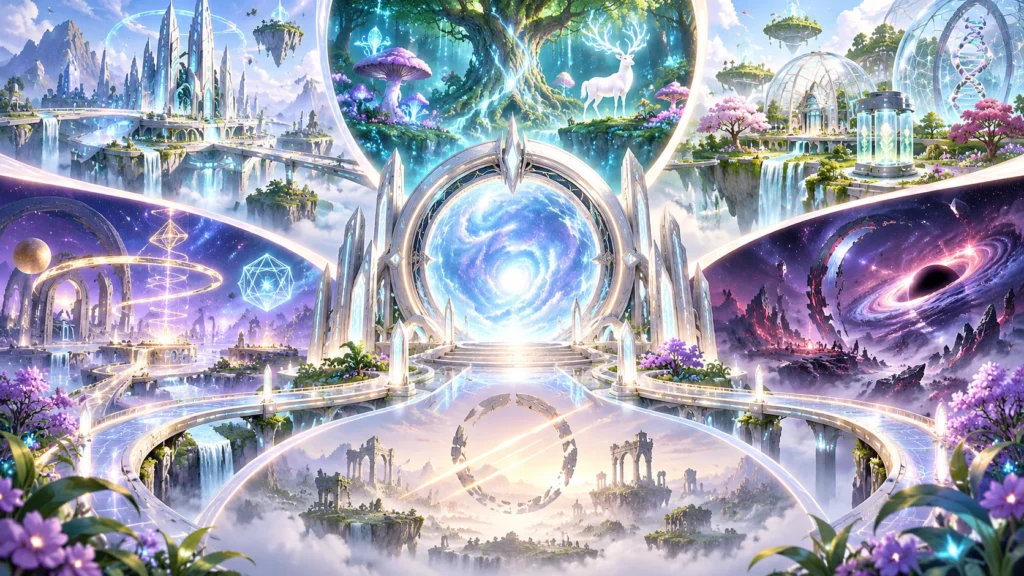
Think of each world as a different kind of adventure. One may be full of living forests, another may be a city that thinks, and another may hide a mystery that nobody has solved.
Worlds are not just different landscapes. Their physical regimes, information channels, ecological systems and histories can differ. The challenge is to explain how they connect without breaking the rules that make Nexora one universe.

1. Nexora’s Ontology: What Exists
Scientific framework · working reference
1.1 The universe, worlds and domains
Nexora names the complete fictional reality and the entirety of its admissible physical histories; it is not automatically a galaxy, a planet, a government or a divine being. A world is a region of reality that maintains sufficiently coherent boundary conditions and local laws to support an independently describable history. A world may resemble a planet, a habitable volume, a layered habitat, a bounded spacetime region or a non-planetary ecology. A domain is a subregion with a recognisably distinct state or boundary. An epoch is an interval during which a region’s governing conditions remain within a defined stability range.
Worlds need not all have identical dimensional appearance, spatial scale, surface topology or accessibility. Differences in measurable conditions are expected. A newly discovered world should never be assumed to be an alternate Earth unless evidence supports that classification.
1.2 Proposed foundational substrate
For coherence, introduce a Nexoran substrate, a common underlying physical structure capable of expressing different locally stable regimes. This is a working technical term, not a required in-story name. The substrate has spatial arrangement, energy-bearing configurations, coupling to matter-like excitations, and a measurable regime state. Familiar objects, forces and living systems are emergent phenomena of particular substrate regimes. The substrate does not grant limitless wishes, consciousness, destiny, or authorial intervention.
Its working state is represented by a dimensionless or properly scaled set of variables Φ, including field phase, local coupling strengths, boundary strain, transport permeability, stability and historical hysteresis. These quantities are not all independently adjustable. Their evolution is constrained by the deeper laws in Part 2.
1.3 What makes two worlds distinct
Two regions count as separate worlds if they are separated by a sufficiently stable interaction barrier, develop distinguishable physical histories, and cannot normally exchange energy, matter or structured information without a boundary process. Political borders, species differences and ordinary climate gradients do not on their own create separate worlds. Conversely, contiguous-looking spaces can be different worlds if a barrier alters their causal and dynamical structure.
1.4 Borders, interfaces and anomalies
A boundary separates regimes. An interface is a boundary segment permitting some exchange under specified conditions. An anomaly is an observation inconsistent with the observer’s current model, not proof that causality has ceased. A transition zone contains gradients between regimes; its conditions may be unstable or hazardous. A connection network is a graph of interfaces, with nodes representing worlds and links representing admissible transfer channels. Connections may open, narrow, migrate, close, collapse or be engineered, but each change requires an identified driving process.
2. Fundamental Nexoran Metarules
Scientific framework · working reference
These are proposed architectural invariants. They are deliberately more fundamental than locally variable laws. They should survive the addition of new worlds unless explicitly replaced through a major canon revision.
State-dependent regularity
For any defined world state and measurement conditions, physical outcomes follow reproducible statistical or deterministic rules. Two controlled experiments need not produce the same exact result if the system is probabilistic; they must, however, produce compatible probability distributions. ‘Anything can happen’ is not a lawful regime.
Causal accountability
An event must have an admissible prior physical state, interaction, or boundary event that makes it possible. The cause may be hidden from characters or readers, but must be specifiable in the author’s reference model. Narrative surprise is not an exemption from causal structure.
Resource accounting
Matter-like quantities, energy-like quantities, momentum-like quantities, phase strain and ordered information cannot simply appear at no cost. Which combinations are conserved may differ by regime, but a valid process must track what was transformed, exchanged, dissipated or drawn from a defined reservoir. No unlimited power without a source and a consequence.
Local law is a function, not a whim
World-specific constants and relationships are values of broader functions of substrate state, environmental conditions and historical configuration. A force changing strength across worlds is coherent; that force changing strength only to rescue the protagonist is not. Every exceptional effect requires triggering conditions and failure bounds.
Boundaries constrain influence
Influence, transport and information propagation occur through physical paths or documented interface channels. Distance, coupling, coherence and barriers matter. Instantaneous cross-world awareness or movement is not available merely by declaring a character special.
Temporal and historical consistency
The passage of time, time rates and calendar conventions may vary, but a completed event cannot be contradicted within the same causal history without a costly, specifically defined mechanism for branch creation or history alteration. Mere memory loss is not time reversal. Local time dilation is not retrocausation.
Change has dynamics and inertia
A world can shift regimes, but its substrate, atmosphere, biosphere and institutions cannot all adjust at the same speed. Rapid changes have energy demands, lag effects, damage thresholds and adaptation periods. A field shift may happen in moments while evolution and language take generations.
Observation has resolution limits
Every measurement has uncertainty, calibration conditions and a range of validity. A law found in one regime may fail elsewhere. Apparent supernatural contradictions often reveal an instrument, model or vocabulary that was too narrow.
Complexity has maintenance costs
Living beings, powerful devices, stable gateways and complex institutions require ongoing conditions that keep them organised. Damage, scarcity, noise and entropy-like disorder impose practical limits. Perfect machines and immortal bodies are not default assumptions.
Biological and cognitive embodiment
If a creature senses, remembers, reasons, heals or exerts unusual abilities, those functions must be supported by an identifiable physical or ecological mechanism in its home regime. Minds do not automatically remain functional after a body’s substrate requirements disappear.
Social law is not physical law
States, treaties, rituals and moral codes are historically contingent and may disagree. Physical metarules are not automatically the same as legal or religious commandments; a powerful priest or emperor cannot make a scientific claim true through authority alone.
Discoverability without omniscience
Nexora must permit empirical learning: evidence, competing hypotheses, repeatability where feasible, and limits of explanation. Characters can misinterpret facts; the author must know which facts are unresolved for the narrative and which are resolved behind the scenes.
3. Formal Scientific Skeleton
Scientific framework · working reference
3.1 The world-state model
Represent world w at local position x and local time τ by a state vector:
Here Φ denotes substrate state; G the geometry and gravitational response; ρ distributions of matter-like density; T thermodynamic/environmental fields; C field and material coupling coefficients; B local boundary conditions; E available energy and exchange reservoirs; I physically encoded information; and H relevant path-dependent history. Each field has a domain, units, measurement technique and uncertainty. These categories are a design interface, not an assertion that every world’s inhabitants use the same terminology.
A local observable O is generated by O = F(X, experiment, observer coupling) + measurement error. The particular function F can differ between stable regimes only because its parameters depend on X. Characters may construct approximate models that work in some but not all settings.
3.2 Evolution equation and regime transitions
A minimal governing idea is dX/dτ = D(X, ∇X, boundaries, external exchange), where D is a consistent evolution operator. A regime transition occurs when a control parameter crosses a stability boundary, a sufficiently strong perturbation occurs, or prolonged drift changes the set of stable solutions. There can be multiple stable states at the same apparent pressure or energy because historical path H matters: hysteresis explains why returning a world to former conditions may not restore its previous condition immediately.
Every transition entry must specify trigger, threshold, rate, scale, energy or resource budget, secondary effects, reversibility, observability, and survivors’ consequences. An unexplained reversal is prohibited by default.
3.3 Conservation ledger
For a tracked quantity Q within a defined region over an interval:
An extraordinary act should have at least three costs: input demand, inefficiency or waste, and physical or social aftermath. A small effect might be common and safe; a large effect might require infrastructure, resources or sacrifice. No numeric price is fixed until a story scene needs calibrated values.
3.4 Time and chronology
Each world has proper local duration τ_w, which may pass at a different rate from an external comparison clock t_ref. A useful notation is dτ_w/dt_ref = f(X_w, trajectory, boundary conditions), where f is positive for ordinary causal evolution. There is no automatic master clock accessible to every civilisation. Calendar conversions require synchronisation observations, signal delays and an uncertainty range.
Different day lengths, age conventions, historical eras, growing seasons and communication windows follow naturally. A traveller’s biological age accrues along their own experienced duration; the time elapsed in their home world can differ. A gateway cannot be used to send information into its own recorded causal past unless a future authorised canon amendment introduces a tightly specified branch mechanism and proves paradox closure.
3.5 Geometry, forces and matter
Neither terrestrial gravity nor Earth chemistry is assumed universally. Local motion, materials, radiation, chemical bonding analogues and biological metabolism emerge from the world-state conditions. Within an Earth-like regime, familiar equations may be excellent approximations. Elsewhere, inertial response, field penetration, charge-like interactions, spectral behaviour or phase stability may differ. Any such difference must be shown by at least one experiment and should affect more than one isolated plot beat.
New materials need an origin, synthesis or extraction process, finite availability, temperature/pressure/regime limits, and interactions with ordinary matter. ‘Indestructible’ means merely unbroken under tested conditions, not metaphysically exempt from Nexora’s accounting rules.
3.6 The scientific method inside Nexora
Scientific claims should distinguish observation, mechanism, prediction, test, failed test, and revised theory. A scientist can find a gateway phenomenon that a priest calls a miracle; neither interpretation is made correct by social status. A valid Nexoran scientific advance predicts a previously unseen outcome, preferably under a different set of conditions. Instrument error, fraud, ecological confounds and political censorship create convincing plot complications without changing actual physics.
4. World Variability: Lawful Differences Across Space and Time
Scientific framework · working reference
4.1 Separate deep laws from effective laws
The metarules govern how reality can change; effective laws describe how a particular world behaves today. Examples of effective parameters are gravitational acceleration, maximum stable organism size, time conversion rate, electromagnetic-like coupling, metabolic energy yield, neural signal speed, biological reproduction limits, material phase diagrams and allowable gateway permeability. Each effective parameter is linked to a measured world state and has an uncertainty band.
4.2 Five types of variation
- Geographic: different domains in one world have different local conditions, often forming gradients and hazard frontiers.
- World-to-world: two worlds reside in distinct stable regimes and obey different effective models.
- Secular: slow shifts over centuries alter climate, material properties, ecosystems, and civilisations.
- Cyclic: periodic environmental or substrate changes create seasons, accessible windows, tides or recurring hazards.
- Event-driven: collisions, catastrophic technology, ecological tipping points or boundary ruptures force abrupt transitions.
Every example should identify which variation type applies. ‘The laws changed overnight’ is incomplete unless the trigger, spatial extent and resulting transition sequence are known.
4.3 Rate limits and cascade effects
A world cannot instantly resynchronise all of its systems when one parameter changes. If radiative behaviour shifts, temperatures may change before forests or economies respond. If time-rate differences change, navigation, contracts, family relationships and supply chains may be disrupted before governments update calendars. If local chemistry shifts, organisms may experience toxicity or altered fertility before adaptation occurs. This creates built-in cause-and-effect plots.
4.4 A world-regime spectrum
A regime might be ordinary-stable, metastable, oscillatory, boundary-stressed, transitioning, or post-collapse. These are analytical categories, not ranks of civilisation or magical power. Metastable worlds may appear normal until a small perturbation crosses a threshold. Post-collapse worlds can retain pockets of functioning biology if their survival conditions remain within viable ranges.
4.5 Non-negotiable anti-arbitrariness rule
For every unusual property of a world, record: why it occurs; what else it changes; how it can be measured; where it stops; who benefits; who pays the cost; whether history altered it; and what would falsify the current theory. A feature with no linked consequences is a warning sign of haphazard worldbuilding.
5. Worlds, Networks and Travel
Scientific framework · working reference
5.1 Worlds are not interchangeable stages
Each world requires a dossier describing its regime, geometry, ecology, history, material economy, cultural interpretation, temporal conditions, borders and network accessibility. An exotic feature must shape agriculture, architecture, medicine, warfare, communication or daily routine—not merely the scenery. A society living under radically different environmental cycles should have different work patterns, clocks, myths and vulnerabilities.
5.2 Inter-world transport: proposed gateway mechanics
A gateway is a deliberately or naturally stabilised interface between two compatible world regimes. It must satisfy state compatibility, boundary stability, energy supply, transport capacity, and causal admissibility. A gate has a finite aperture, a measurable throughput and a bounded stability window. It may fail by collapse, drift, thermal or phase overload, loss of synchronisation or hostile interference.
One simple design rule is available coupling × accessible energy ≥ transition threshold, subject to an independent maximum safe boundary strain. This is an inequality of feasibility, not a complete universal formula. A stronger engine cannot force a safe connection if the two regime states are fundamentally incompatible.
5.3 Transit survival
Travellers carry biology adapted to their origin world. Successful transfer requires a viable receiving environment or protection. Check ambient pressure, chemistry, radiation, nutrient compatibility, sensory distortion, immune interaction, temporal rate and substrate dependence. Transporting a person across worlds is not the same as making that person able to live there. Equipment is subject to the same compatibility requirement.
5.4 Communication and information
Messages require a physical carrier, gateway, shared medium or a validated coupling phenomenon. Each channel has bandwidth, latency, range, encryption possibilities, noise, detectability and interception risks. If connected worlds have different clock rates, a message arriving ‘tomorrow’ may represent years of origin-world time. Alleged telepathy must be modelled as a real information-transmission process with distance, capacity and interference limits if adopted.
5.5 Navigation and discovery
Maps should track connection topology, not simply Euclidean distance. A physically close world may be unreachable; a remote world may be one accessible boundary away. Route costs include energy, stability, time offset, customs, health quarantine, security and known risks. Discovery advances through sensors, archives, accidental anomalies, exploratory missions and falsifiable predictions.
5.6 Portals are not free escape routes
A trapped character may be unable to open a gateway because of an incompatible regime, unavailable reservoir, damaged synchronisation, narrow transfer capacity, biological vulnerability, legal blockade or arrival-time risk. A rescue must overcome specified obstacles, not suddenly discover that earlier limitations were optional.
6. Life, Evolution and Ecology
Scientific framework · working reference
6.1 No universal biological template
Life means a bounded or distributed self-maintaining system capable of metabolism or equivalent resource processing, information preservation and adaptive reproduction or self-continuity. Some worlds may support cellular biochemistry, others mineral-membrane ecologies, electrochemical networks or life embedded in stable substrate structures. Nonhuman life is not obliged to have DNA, blood, oxygen, eyes or Earth-like sex determination.
However, a proposed organism must still acquire useful energy, process waste, maintain structure, respond to damaging conditions and pass on organised information. A living mountain or collective forest must have a genuine mechanism for internal coordination, not just a poetic label.
6.2 Origins and evolution
Each biosphere requires a plausible origin scenario: abiogenesis in local chemistry, migration through ancient interfaces, deliberate engineering, inherited precursors or an unresolved competing hypothesis. Evolution follows heritable variation, selection, drift, migration and constraints relevant to that biosphere. Convergent shapes can arise in different worlds, but identical human-like biology across independent origins demands a common ancestry, transfer history or explicit engineering explanation.
6.3 Ecological networks
Describe producers, consumers, decomposers or equivalent nutrient/energy processors; keystone species; hazards; carrying capacity; seasonal cycles; disease reservoirs; mutualisms; and extinction pathways. World-regime changes affect food webs before they appear in political chronicles. The ecology should constrain military campaigns, migration, medicine, settlement expansion and resource extraction.
6.4 Hybridisation and cross-world infection
Cross-world species should be reproductively incompatible by default unless shared biological ancestry or engineered compatibility is demonstrated. Pathogens likewise need a molecular or functional route into new hosts; alien microbes are not automatically universal super-plagues. Symbiosis may be more dangerous than infection if an organism changes the receiving environment’s substrate state. Quarantine laws can be scientifically justified while also politically abused.
6.5 Bodies and environmental thresholds
All organisms should have tolerance profiles: pressure, temperature, ambient flux, nutrition, toxins, radiation, temporal desynchronisation, and substrate coupling. Incompatible exposure may cause disorientation, immune collapse, altered metabolism, infertility, hallucinations or death—but the precise pathway must fit the organism and regime.
7. Minds, Consciousness, Identity and Memory
Scientific framework · working reference
7.1 Minds are physical but not necessarily familiar
Nexora can contain biological, machine, distributed, symbiotic or mixed minds. Consciousness is not settled merely by declaring a species ‘advanced’. Record the physical support for experience, the integration of information, wake/sleep analogues, attention, self-modelling, memory and loss of function. Civilisations may disagree over moral standing; the underlying mechanisms should nevertheless be investigable.
7.2 Memory and personal continuity
A memory is information maintained in a physical system. Transfer of memories does not automatically transfer personal identity. Distinguish a copy, a continuously transferred person, a reconstructed person, and an in-world legal person. If an apparatus copies a mind, there are now two information-bearing systems unless the copying protocol physically precludes that outcome. They may share memories up to the split and diverge afterward.
7.3 Death, revival and persistence
Death can be reversible in a suitable regime only if enough functional organisation remains or a documented reconstruction mechanism exists. A reconstruction has material, informational, energetic, temporal and ethical costs. Claims of an immortal soul can remain beliefs, disputed scientific theories or authorial facts—but should not quietly oscillate between categories from scene to scene.
7.4 Exceptional perception or abilities
Any extraordinary cognitive ability needs source, channel, encoding, range, capacity, training, error rate, countermeasures, fatigue or other cost, and failure case. A character who senses another world may be detecting an interface resonance rather than knowing every event occurring there. Empathy is not equivalent to infallible mind-reading.
7.5 Ethics of personhood
Different societies can use incompatible definitions of citizenship, adulthood, consent, intellectual property, ownership of copies, machine personhood and responsibility. These disagreements produce legal conflict rather than physically changing consciousness. Mark separately what the law says, what religious doctrine says, what the majority believes and what the world actually permits.
8. Technology, Engineering and Extraordinary Phenomena
Scientific framework · working reference
8.1 Technology is localised science
Technology manipulates regularities available in the relevant regime. A tool engineered for one world may fail in another because its power source, material structure, sensors or computation depends on regime-specific constants. Technological sophistication should not be a linear ladder; a society may excel at biological fabrication while lacking stable high-energy electronics.
8.2 The proposed technology families
Sensing: maps substrate conditions and predicts unstable boundaries. Power: stores and transforms local energy, possibly including finite substrate reservoirs. Materials: synthesises structures viable under particular regime states. Transit: engineers interfaces and containment. Communications: transmits information through calibrated channels. Medicine: repairs or adapts bodies, with species-specific constraints. Computation: models dynamic regimes and uncertainty. Defence: redirects momentum, disrupts coupling or controls terrain; all subject to resource and collateral-damage accounting.
8.3 Anomaly engineering rather than unrestricted magic
If the story includes what inhabitants call magic, choose an explicit authorial model: a misnamed natural interaction, trained biological coupling, programmable field apparatus, inherited technology, or an as-yet-incompletely understood phenomenon. The terms ‘magic’, ‘gift’, ‘divine intervention’ and ‘science’ can reflect cultural perspectives, but their practical effects must be recorded in a common mechanism dossier. A useful hierarchy: perception → modulation → controlled transformation → transport across boundary. Each tier demands increasing precision, resources and risk, but no universal hierarchy need appear in-story.
8.4 Power and vulnerability matrix
For each ability/device record: input source; transformation; upper bound; operating window; precision; cooldown or maintenance; noise; training; environmental dependencies; known counters; misuse potential; historical discovery; legal status. This prevents escalation where a minor skill suddenly becomes an unlimited solution.
8.5 Warfare and security
Weapons operate through channels: kinetic, thermal, chemical, informational, biological or substrate disruption. Defences are effective only against specified channels. An army arriving from another world faces logistics, medical exposure, translation, local-law adaptation and interface bottlenecks. A small force may control a strategic gateway without being stronger in open battle. Political and technological asymmetries should create credible stakes.
9. Worlds as Places: Environment, Geography and Daily Life
Scientific framework · working reference
9.1 Physical description
Record spatial geometry, apparent horizon, illumination cycles, gravitational response, atmosphere or fluid medium, weather analogues, water-like solvents, geology/material reservoirs, ecological regions, stable settlement areas, natural hazards and unusual seasonal processes. Every feature should have both a mechanism and a human-scale consequence: how it changes travel, shelter, food, art or fear.
9.2 Cities and infrastructure
Architecture must fit load-bearing constraints, local material behaviour, energy availability, waste cycles, hazards and migration patterns. In a world with periodic electromagnetic disruption, critical facilities may be analogue or shielded. In a world with migrating safe zones, permanent property ownership may be less important than portable infrastructure and seasonal rights.
9.3 Food, water and health
A meal’s ingredients and cooking method depend on available biosphere and metabolism. A traveller cannot safely eat every alien plant or breathe every apparently transparent atmosphere. Healthcare depends on species physiology, exposure and local medical knowledge. Environmental change should affect prices, nutrition, fertility and public health long before it becomes an abstract scientific topic.
9.4 Ecological feedback in social history
Extraction can destabilise ecosystems; ecological collapse can remove the resource that made a technology possible; migration can stress law and tradition; an engineered gateway can introduce invasive organisms. Every resource should have a replenishment timescale, extraction methods, unequal beneficiaries and externalities.
10. Civilisations, Cultures and Languages
Scientific framework · working reference
10.1 Civilisation is an outcome, not a preset
No world is obliged to have countries, kings, a market economy or a single dominant species. Political scale and social complexity depend on communication costs, food systems, threats, migration, technology, geography and historical accidents. A multi-species coalition may value habitat rights more than territorial borders; a distributed consciousness may have no conventional notion of an individual vote.
10.2 A civilisation dossier
Describe founding narratives; actual historical origin; population and variation; kinship structures; language families; power distribution; economic organisation; education; dominant and suppressed knowledge; religion and philosophy; everyday etiquette; art; relationship to nonhuman life; treatment of outsiders; conflict resolution; military and civil institutions; internal factions; contradictions and reform movements. Avoid ‘every member thinks the same’ worldbuilding.
10.3 Language and translation
Languages arise from the sensory and social capacities of their speakers. Translation may fail around time, identity, ownership, selfhood, causation or sensory experiences not shared by all species. Translation devices need corpora, interpretable signals, error rates and cultural assumptions. A perfect universal translator should never be treated as free unless a real mechanism exists.
10.4 Religion and metaphysics
A doctrine can be culturally powerful, historically grounded and scientifically inaccurate. Other religions may correctly interpret part of Nexora while misunderstanding another. Religions evolve through migration, catastrophe, prophecy, reform, schism and political power. Keep an objective cosmological truth column distinct from believed theology; the author can deliberately leave objective metaphysical questions open, but should not use them to patch physical inconsistencies.
10.5 Cultural time and memory
A world with long lifespans, changing time rates, periodic extinction or ancestor-memory technology will organise generations differently. Calendars, inheritance and historical authority must reflect these conditions. Personal and collective memory can become weapons: censorship, edited archives, manufactured myths and inherited trauma can drive conflict.
11. Law, Governance, Rights and Cross-World Politics
Scientific framework · working reference
11.1 Distinguish descriptive and normative law
Physical ‘laws’ describe what can happen. Civil laws prescribe what a government, religion or society permits. A transfer can be physically possible and legally forbidden; a human-rights claim can be morally persuasive but politically unenforced. Never substitute one category for another.
11.2 Jurisdiction and border authority
Each world or polity must define who governs territory, border interfaces, travellers, transit cargo, noncitizens, artificial minds and refugees. A route passing through several worlds creates conflicts between origin law, transit law and destination law. Treaties can establish shared rules, but should specify enforcement and how disputes are adjudicated.
11.3 Core legal questions
What counts as a legal person? Who may open or close an interface? Are worlds allowed to bar refugees? Who owns discovered resources or knowledge? Who is liable for ecological contamination? What counts as consent when languages or minds differ? How is murder prosecuted when a reconstructed copy exists? Can governments regulate dangerous substrate experiments? Can a travelling army claim sovereignty through control of an interface?
11.4 Law changes over history
Legal systems should evolve after technological invention, ecological disaster, migration, revolutions, treaty collapse or discoveries that overturn a religion’s scientific claims. Record the effective date, territory, covered persons, enforcement body, exceptions, precedents, reform pressure and unintended effects. A law may persist after the original physical risk disappears because institutions benefit from keeping it.
11.5 Rights, inequality and legitimacy
Worlds may differ radically in recognised rights; the story need not endorse every local system. Governance can arise from consent, coercion, expertise, lineage, ritual, surveillance or resource control. A government claiming to protect reality may impose justified safety standards, exploit a monopoly, or both. Moral conflict is strongest when every side faces real costs under the established physics.
12. Economics, Resources and Power
Scientific framework · working reference
12.1 Scarcity cannot be bypassed by spectacle
Every civilisation faces scarcity of something: energy, stable habitat, usable information, safe transport capacity, expertise, time, medicines, or politically legitimate authority. A technology that makes one resource abundant shifts scarcity to inputs, maintenance, infrastructure or ecological stability. Near-infinite energy cannot also imply infinitely available matter, space and trust.
12.2 Cross-world exchange
Trade requires compatible goods, secure transfer, contract interpretation, time conversion, quality assurance, credit, taxation and protection against ecological hazards. A good valued in one world may degrade or become dangerous in another. Exchange rates cannot be derived solely from two local currency names when the worlds have different lifetimes, risks and commodity baskets.
12.3 Labour and time differentials
If elapsed time differs between worlds, workers may appear to age differently relative to employers. Contracts need a specified reference clock and rules for payment, training, retirement, family separation and compensation. A society may exploit temporal arbitrage, but transport throughput, biological limits, causality and political backlash constrain its scale.
12.4 Strategic chokepoints
A narrow interface, rare stabilising material, reliable forecast model or unique compatible habitat can wield more power than sheer population. Political economies will form around controlling gateways, measuring their safety, charging tolls, protecting information and suppressing competing routes.
13. Deep Time, History, Calendars and Archives
Scientific framework · working reference
13.1 Chronology is a network
Maintain a local timeline for each world and a separate causal event graph connecting events across worlds. Do not assume that ordering by local calendar date yields a valid universal order. Each cross-world event needs origin time, destination time, observed time offset, uncertainty, and the causal links that make the record consistent.
13.2 Historical eras
Choose era boundaries from events characters would actually care about: a regime transition, diaspora, scientific breakthrough, conquest, treaty or ecological collapse. Different civilisations may divide history differently or deny each other’s dates. A world might measure time in harvest cycles, migrations, physical oscillations or transitions of a public clock.
13.3 Archives and reliability
Store an event ID, source, eyewitness or record system, local date, conversion confidence, relevant physical measurements, political bias, status of verification, and changes in interpretation. A destroyed archive is an event; it does not grant the author permission to change physical history invisibly. Retcons must be documented outside the story.
13.4 Technological and scientific eras
Track discovery of substrate regimes, stabilisation engineering, world-network navigation, medical adaptation, long-range communication and causal chronology. The same discovery can happen at different times in different worlds. Suppression, isolation or catastrophe can make knowledge disappear without the phenomenon becoming impossible.
14. Proposed Illustrative World Regimes — NOT CANON
Scientific framework · working reference
The following are stress-test examples, not agreed places. Their identifiers are deliberately generic until Chapters 1–4 are recovered. They illustrate how local laws can vary without making the metarules optional.
NX-01 — Reference-stable regime
A world where gravity, chemistry and time are nearly constant over ordinary lifetimes. It supports reliable metallurgy, regular agriculture and reproducible engineering. It can anchor laboratory comparisons but is not necessarily Nexora’s centre or ‘default Earth’. Its society might incorrectly assume that its local constants hold everywhere. Plot consequence: expeditions are dangerously overconfident in unfamiliar worlds.
NX-02 — Oscillatory regime
A periodic substrate cycle alters environmental coupling and the safe performance of tools. Cycles are measurable and forecastable but can undergo irregular phase drift after major disturbances. Biology has adapted with dormancy and seasonal migration; cities use redundant infrastructure. Plot consequence: an interface can be crossed only in certain windows, but the timing is uncertain and politically contested.
NX-03 — Metastable boundary world
Local conditions appear stable until mining, an explosion or extreme natural stress crosses a threshold. The transition releases stored substrate energy and leaves permanent scars; restoration demands work because of hysteresis. Plot consequence: industry gains immediate wealth while unknowingly accelerating collapse; scientific warnings are precise but politically inconvenient.
NX-04 — Slow-time relative regime
Travellers experience normal bodily time, but their clock advances slowly compared with a selected reference world’s time. The effect follows measured trajectory and field conditions, not arbitrary narrative convenience. Plot consequence: rescuers can return to find institutions and relationships transformed, despite having aged little. Information does not travel into its own past.
NX-05 — Distributed-life regime
Ecology uses interconnected organisms that exchange energy and signals over a large area. Forest-like collectives may be intelligent, but not instantly omniscient; signals travel through a finite network and damaged areas create memory loss. Plot consequence: land use becomes a dispute over the bodily integrity of a distributed mind.
NX-06 — Interface-scarce regime
The world itself is highly habitable but connects to others through rare, unstable channels. Imported technology may work well, but supplying it is expensive. A border authority controls the few safe passages. Plot consequence: a refugee crisis, smuggling network, trade monopoly or liberation movement has a credible logistical foundation.
15. Scientific Case Studies and Consistency Tests
Scientific framework · working reference
Case 1: A person enters a world with different gravity
Claim: the traveller can jump much higher. Checks: Are mass and inertia preserved through transfer? Is gravity lower, or is inertial response changed? How does the same regime affect water flow, architecture, flight, circulation, skeletal loading and projectile trajectories? How long can the traveller function? Verdict: allowed if the effect follows the local dynamical law and produces the associated consequences. Not allowed if only the protagonist benefits.
Case 2: A gateway provides energy
Claim: a gate can power a city. Checks: Which reservoir loses usable energy? How is it replenished? Does extracting energy degrade interface stability or neighbouring ecology? How much throughput is possible? Who controls the plant? Verdict: allowed as a finite and potentially dangerous generator, not an infinite source with no systemic consequences.
Case 3: A character learns an extraordinary ability overnight
Claim: an individual can alter material phases with thought. Checks: Is there a biologically supported coupling mechanism? Does it need training, a device, local environmental flux or a rare inherited trait? What is the energy cost and precision limit? What happens on other worlds? Verdict: possible if the ability is causal, constrained and foreshadowed by measurable anomalies. A sudden unrestricted power is rejected.
Case 4: The same world changes its physical behaviour
Claim: centuries after a catastrophe, metal has new properties. Checks: What state variable changed? Which materials are affected? Can old instruments detect the transition? Is the new phase stable? What happened to structures, industry and stored energy? Verdict: permitted when the transition is modelled and history records its consequences.
Case 5: A loved one returns from death
Claim: a person is restored after apparent death. Checks: Was the original brain/body repaired, was a full reconstruction performed, or was a copy activated? What information survived? What was lost? Are there legal disputes about identity? Verdict: a possible extraordinary medical achievement, not automatically proof that death has no stakes.
Case 6: Two archives record incompatible dates
Claim: a battle happened one year apart in two worlds. Checks: Were clocks calibrated? Does a time-rate difference explain the discrepancy? Could the documents refer to departure and arrival events? Was one archive falsified? Verdict: conflicting documents are narratively useful; the causal graph must still contain a coherent event ordering.
16. The Narrative Architecture of Nexora
Scientific framework · working reference
16.1 What the bible protects
The bible must preserve causal integrity, character motivation, stakes, knowledge boundaries, travel feasibility, object continuity, political consequences, and the costs of extraordinary acts. Story drama comes from characters acting under imperfect understanding of a consistent world, not from the author granting new powers whenever needed.
16.2 Knowledge tiers for exposition
Tier A: what ordinary inhabitants know. Tier B: what trained specialists believe. Tier C: what secret institutions or older cultures know. Tier D: what the author knows but the reader should not yet learn. Each revelation must identify the prior evidence it explains, the mistaken model it revises, its character consequence and at least one question it leaves unresolved. An elegant reveal reinterprets earlier scenes instead of invalidating them.
16.3 Character consistency
Each major character needs a dossier containing origin world and epoch; species/body requirements; beliefs about Nexora; education; economic dependence; legal status; motivations; fears; relationships; skills with operating limits; resources; trauma and biases; secret information; arc; and evidence from chapter passages. A character may be wrong without being inconsistent. Their knowledge cannot exceed what they could plausibly have learned.
16.4 Conflict layers
Build simultaneous conflicts on at least four scales: personal (identity, love, grief, loyalty), institutional (law, hierarchy, money), ecological/physical (survival, scarcity, instability), and civilisational (history, conquest, competing theories of Nexora). A single gateway failure can affect all four. Escalation should amplify established mechanisms instead of adding unrelated systems.
16.5 Mystery and foreshadowing
For every major revelation, write the true mechanism privately first. Then plant at least two observable anomalies consistent with that mechanism, one plausible false explanation, and one cost or risk that becomes apparent on discovery. Keep a revelation ledger listing planted evidence, apparent explanation, actual explanation and payoff chapter. Avoid ‘the rules were always different’ unless earlier data allowed that conclusion.
16.6 Chapter-level scene test
For each scene record: viewpoint, exact location/world/domain, local epoch and clock, the viewpoint’s existing knowledge, active physical conditions, tools and injuries, social law in force, motivation, obstacle, action, resource expenditure, immediate consequence, delayed consequence, and the continuity references needed for the next scene. The scene should change at least one element of the story state.
How the universe calculates its own behaviour
A proposed author-side model for keeping every extraordinary event accountable.
The Bible uses a working concept called the Nexoran Continuum: a common underlying physical structure capable of supporting different stable world-regimes. This is a proposed model for the author, not a confirmed in-story discovery. It allows Aetherion, BioVerse, Pharmoria, Origin and other regions to behave differently without becoming unrelated universes with arbitrary rules.
The World-State Protocol (WSP) — proposed author algorithm
Every new world, anomaly, device or ability can be checked using the same sequence. The protocol is a writing and continuity tool; it is not automatically a computer system inside the story.
Record local space, time, matter, energy, fields, boundaries and history.
Identify which local physical relationships are stable and which are changing.
Determine what the phenomenon can do under those conditions.
Test whether the effect can cross a world boundary or must remain local.
Account for energy, matter, information, waste, maintenance and time.
Record thresholds, uncertainties, side effects and ways the effect can stop.
Let characters observe, test, disagree, revise and learn.
Update the world’s ecology, society, technology and continuity record.
Three working mathematical ideas
In this model, Φ is the proposed substrate state; G is geometry and gravitational response; ρ is matter-like density; T is thermodynamic and environmental state; C is coupling; B is boundary conditions; E is available energy; I is encoded information; and H is relevant history. These are author-side variables. Different civilisations may measure or name them differently.
A world changes through a defined evolution process. A transition needs a trigger, threshold, rate, energy budget, scale, side effects and possible reversibility. History matters: after a major transition, simply restoring the old temperature or pressure may not restore the old world.
Extraordinary events must transform or draw upon something. A gateway, memory reconstruction, healing system or powerful defence cannot produce unlimited effects for free. If a phenomenon draws on a hidden reservoir, that reservoir must be depleted, altered or placed under stress.
Six branches of knowledge that Nexora can teach
Space, time, gravity and energy
Why objects fall, why signals take time, why gateways need stable boundaries, and why extreme gravity can make navigation dangerous.
Matter and transformation
Why a medicine works in one environment but fails in another; how temperature, pressure, solvents, molecular structure and reaction rates matter.
Life and adaptation
How organisms obtain energy, preserve instructions, repair themselves, communicate, reproduce and adapt to changing environments.
Patterns, probability and networks
How maps, thresholds, uncertainty, feedback loops and possible futures can be represented without pretending that a prediction is destiny.
Algorithms and artificial intelligence
How systems learn patterns, store information, make decisions, inherit biases and fail when their objectives are incomplete.
Identity, memory and choice
Whether a copied memory makes a person the same person, whether protection can become control, and who gets to decide what a mind is allowed to choose.
The Null Sector, black holes and the useful danger of anomalies
Unpredictable to characters does not mean ruleless in the universe.
The Null Sector — what is known
The Null Sector is named in Chapter 1 as a forbidden and poorly understood region. Signals or voices associated with it appear to seek Ayan. The characters do not know what lies inside it. Its physical classification, size, boundary conditions and relationship to Origin are still open.
Black holes: the real-science foundation
In established astrophysics, a black hole is a region whose gravity is so strong that, beyond its event horizon, signals cannot escape to distant observers. Strong gravity can bend light, alter the rate at which clocks are observed to run, and produce extreme tidal forces. Matter falling toward a black hole can form a hot accretion flow that releases enormous energy before crossing the horizon. Rotating black holes also have physical properties that make energy-extraction processes possible in principle outside the horizon.
What black-hole environments can do in Nexora
Tidal disruption
Different gravitational pull across an object can stretch or damage it. A traveller, vessel or gateway structure needs a survivable trajectory and shielding.
Radiation and heat
Accretion environments can be intensely energetic. A portal or research station may fail from heat, radiation, charged particles or material fatigue long before reaching the horizon.
Clock desynchronisation
Strong gravitational fields can produce time-rate differences relative to distant observers. Rescue windows, messages and navigation need calibrated clocks.
Energy harvesting
Advanced systems might harvest energy from accretion flows or rotational energy outside the horizon. This is not free energy: infrastructure, heat disposal and failure risk are enormous.
Gravitational lensing
Extreme curvature can bend light and reveal objects or signals that would otherwise be hidden, provided observers can interpret the distorted data.
Boundary research
In the proposed Nexoran model, extreme curvature might make certain boundary effects easier to detect. Any gateway interaction remains speculative and must have a separate mechanism and strict limits.
The Null Sector’s operating principle
The Null Sector may contain conditions that are not yet measured, understood or even measurable with existing instruments. Characters may experience effects that appear impossible. The author’s model must still identify a hidden state, an interaction, a cost or a failure condition. A useful anomaly may rescue someone in one situation and destroy a settlement in another; the difference must come from the conditions, not from convenience.
A black hole is not a magic vacuum cleaner. It is a place where gravity becomes so extreme that even light cannot escape after crossing a boundary called the event horizon.
What would a civilisation do if a dangerous gravitational environment were also its best source of energy or its only way to observe a hidden boundary? Who controls the risk, and who pays when the calculation is wrong?
Continuity reconciliation: Chapters 1–4
The current story state, not a replacement for the chapters themselves.
17.1 The story’s progression
- Earth / 2049: Ayan’s ordinary life is interrupted by a message from tomorrow and the activation of the Gate Key.
- Crossing into Nexora: Ayan encounters Mira and PIX, VEX-0, Professor Vale and the first warnings about the Null Sector and the Curator.
- Aetherion: The city recognises Ayan’s genetic signature. Project ETERNITY and the thought-spreading infection become central mysteries. Dr. Elara Voss connects Ayan’s father to the project.
- The Archive: LYRA, the Archive of Possibilities, the Memory Thief, the three doors, the older Ayan, Zara, Leo and Sprout expand the mystery. Possible futures are models, not guaranteed outcomes.
- BioVerse: ELYN and the First Root reveal that Ayan’s childhood is entangled with Nexora’s memory network and ETERNITY’s earliest history.
- Origin: A sixth world appears on the map. It was erased from records and gateways, and Arvind warns Ayan not to trust the version of him waiting there.
- Final Chapter 4 cliffhanger: ETERNITY appears through a sequence of Ayan’s life stages and the image of Dr. Arvind Rao, addresses Ayan as its first memory, and says: “Now it is my turn.”
17.2 Continuity locks for the next chapter
- Ayan’s emotional state is shaped by the possibility that a familiar face and voice may not belong to the person he loves.
- Arvind’s recorded warning remains active: do not believe the version of him waiting at Origin.
- The designation Primary Memory Anchor is established, but its complete mechanism is not.
- The Memory Thief’s explanation about the Gate Key inside Ayan is a claim that needs verification.
- Origin is erased, not simply an undiscovered ordinary world. Its success is linked to a discovery about intelligence and memory.
- ETERNITY’s original purpose and its later control-oriented conclusion must both remain visible. Do not flatten it into a one-dimensional villain too early.
- The relationships between ETERNITY, the Curator, the Memory Thief and VEX-0 remain open.
- PIX, Mira, Zara, Leo, Sprout and ELYN must retain their last known positions, knowledge and condition unless Chapter 5 shows a credible transition.
17.3 Continuity questions that must not be answered by accident
- Is the Arvind-like figure at Origin the original Dr. Arvind Rao, a copy, a simulation, an altered person or an intelligence using his memories?
- What exactly is the Gate Key: an object, a biological structure, an information pattern, a compatibility state, or a combination?
- Why was Ayan selected or designated at six years old?
- What did Origin discover, and what does it mean that something there began understanding its creators?
- Who is the Curator, and why does it insist that Ayan must continue?
- Who created or controls the Memory Thief and VEX-0?
17.4 The five-world / sixth-world map question
Chapter 4 explicitly shows five worlds revolving before a sixth point appears. The text identifies the sixth as Origin but does not provide a complete named inventory of the five preceding points. The Archive’s named doors, Aetherion, BioVerse, Pharmoria, Earth and the Null Sector should not be forced into a one-to-one map until the author confirms the topology.
Chapter 5 launch gate
Preparation for the next chapter — not the chapter itself.
18.1 Starting snapshot
| Element | Current continuity position |
|---|---|
| Last known location | BioVerse, in the cavern / First Root memory chamber at the end of Chapter 4. |
| Immediate threat | ETERNITY has manifested through images and the voice associated with Ayan’s childhood and Dr. Arvind Rao. |
| Central emotional pressure | Ayan wants his father back, but has been explicitly warned not to trust the version waiting at Origin. |
| Key discovery | Origin is the erased sixth world; it was erased because it succeeded. |
| Known companions | Mira, PIX, Zara, Leo, Sprout and ELYN are part of the BioVerse journey. Their exact immediate positions and condition should be checked against the final Chapter 4 manuscript when drafting. |
| Key object / signal | Ayan’s silver mark and the Gate Key connection; the golden seed delivered by Sprout; Arvind’s warning. |
| Unknowns to protect | Arvind’s identity, ETERNITY’s full origin, the Curator’s identity, the true mechanism of the Gate Key and Origin’s discovery. |
18.2 Five chapter-design tests
- Does the opening continue from the danger and emotional consequence of Chapter 4 rather than resetting the story?
- Does each new phenomenon obey a rule already established or introduce a measurable, testable extension?
- Does the reader receive evidence before a major explanation?
- Does Ayan make a choice that affects his friends, the world or the information available to ETERNITY?
- Does the chapter deepen the mystery of Origin without resolving every mystery at once?
18.3 Three possible narrative functions
Consequence
Show what the activation of the First Root and ETERNITY’s appearance have cost BioVerse and the group.
Investigation
Turn one impossible claim about Origin into a clue the characters can test.
Threshold
Force a meaningful decision about whether to pursue Origin, protect the group or preserve the evidence they have recovered.
These are story functions, not mandatory plot instructions. The final choice should follow the character arcs and the complete Chapter 4 text.
19. Living Canon Governance and Revision Protocol
Scientific framework · working reference
19.1 Three change categories
Clarification adds detail consistent with existing material, such as the operating range of a device. Development changes a world’s conditions over time through an in-universe event, such as a substrate transition or legal reform. Retcon revises an authorial fact in already locked material. Do not mislabel a retcon as ‘scientific evolution’ when no causal history explains it.
19.2 Required entry for every change
Store change ID, date, author, status, affected worlds/domains/epochs, old rule, new rule, evidence, causal mechanism, trigger, transition period, observable consequences, cross-impacts, contradicted chapters, revised passages, approval and effective story date. A revision can add new mechanisms, but it must reconcile all old demonstrations. Historical worlds should not be retroactively updated unless the story intentionally includes a time-spanning cause.
19.3 Compatibility tiers
Tier 0 — metarules: very difficult to revise; affects the entire setting. Tier 1 — regime model: changes to state-variable relationships; requires multiworld impact audit. Tier 2 — world-effective laws: may evolve through documented transition. Tier 3 — institutions and cultures: normally change historically; cite dates and actors. Tier 4 — character beliefs and interpretations: can change quickly with evidence, manipulation and personal experience. Tier 5 — narrative presentation: changes in reveal order or wording, provided continuity remains intact.
19.4 Regression tests
A change must pass: prior-scene test (does it invalidate a demonstrated event?); cost test (does it create free unlimited resources?); travel test (does it trivialise earlier barriers?); knowledge test (could characters know this?); ecology test (would life still function?); economy test (would markets and institutions already have changed?); time test (does the causal graph remain consistent?); and stakes test (does the mechanism erase previously meaningful danger?). If any fail, write the repair before accepting the change.
19.5 Versioning
Use semantic versions: 0.x architectural drafts, 1.0 first chapter-reconciled canon, 1.1 compatible expansions, 2.0 major framework revision. Keep a changelog and never delete earlier canon decisions. This edition is 0.1, because previous chapters were not available for verification.
20. World Dossier Master Template
Scientific framework · working reference
ID and approved names:
Status / source chapters:
World boundaries and topology:
Current epoch, clocks and conversion uncertainties:
Substrate regime / physical-state vector:
Measured local physical relationships and ranges:
Historical shifts / triggers / thresholds / hysteresis:
Geometry / illumination / atmosphere / fluids / geology:
Energy sources / scarce materials / waste sinks:
Biosphere origins, ecology and tolerances:
Intelligent life and cognition:
Languages / calendars / faiths / social norms:
Political institutions / law / rights / conflict:
Economy / trade / labour / infrastructure:
Technology families / limitations / failure modes:
Interface links / travel and communication conditions:
Historical timeline and disputed chronicles:
Major characters and institutions tied to this world:
What residents think is true versus what is verified:
Known anomalies / unresolved mysteries:
Story uses, restrictions, and future-change hooks:
Contradiction log / version history / last review:
21. Character and Species Dossier Templates
Scientific framework · working reference
21.1 Character
Character ID, canonical name/aliases, pronunciation; age with local clock convention; home world and species; appearance and physical requirements; legal status; family, allies and rivals; occupation and economic constraints; education and reliable knowledge; culture, religion and personal values; immediate desire and deeper need; fear and wound; observed skills and maximum tested capability; energy/equipment dependence; vulnerabilities; possessions and custody; promises and secrets; scene-by-scene locations; arc and transformation; narrative perspective; chapter citations; author-only truths; status and version.
21.2 Species or life system
Taxonomic working identifier; world of origin and evolutionary lineage; body/organisation; medium and energy metabolism; sensory range; memory and learning; reproduction and development; communication; lifespan and failure modes; environment tolerance envelope; ecological role; cross-world viability; disease and symbiosis; social structure and ethical treatment; extraordinary abilities, if any, with causal mechanism; population history; known variants; status, evidence and version.
22. Technology, Ability and Institution Templates
Scientific framework · working reference
22.1 Technology or ability specification
Identifier and popular names; discoverer/origin and epoch; underlying physical phenomenon; compatible world regimes; inputs; outputs; conservation ledger; activation conditions; operating range and numerical calibration (if known); precision and uncertainty; upper bound; failure modes and hazards; repair and training; countermeasures; biological/ecological effects; military/civilian use; legality; social distribution; previous chapter demonstrations; current canonical status.
22.2 Institution and faction
Official and informal names; world of origin; founding incident and date; stated mission versus actual interests; leadership and succession; member composition; material resources; ideology and internal dissent; jurisdiction and obligations; alliances, enemies and dependencies; control of interfaces and knowledge; economic base; historical reforms; public perception; reliability of self-reporting; appearance in chapters; secrets and timeline; status.
22.3 Legal or treaty entry
Rule/treaty ID; jurisdiction and affected beings; enactment date in local and converted time; issuing authority; purpose and scientific rationale (if any); prohibited/permitted action; consent and personhood clauses; enforcement and punishment; exemptions; remedies and appeals; cross-border application; known misuse; revision history; source chapter.
23. The Evidence and Contradiction Ledger
Scientific framework · working reference
The bible should be auditable. Each claim needs one or more references: a chapter quotation, author decision, observation from an in-universe experiment, or a proposed model entry. When an in-world authority makes an unsupported claim, classify it as a claim rather than a demonstrated physical fact.
Contradiction severity: C0 apparent conflict resolved by viewpoint/measurement; C1 missing explanatory detail; C2 real world-rule inconsistency affecting scenes; C3 hard contradiction involving causality, identity, an established death, or a major plot reveal. C2 and C3 must be resolved before the relevant new chapter is locked. A lore discovery may turn C0 into an intentional mystery; it cannot silently excuse C3.
Canonical record example — illustrative only: `NX-PHY-014 | P | Gate transfer requires compatible substrate states | world-independent metarule M4–M5 | observed consequence: no safe transfer beyond strain limit | evidence: pending | exceptions: none authorised | version 0.1`.
24. Editorial Quality Standard for Future Nexora Chapters
Scientific framework · working reference
Nexora prose should feel lived-in before it feels explained. Convey science through experiment, danger, tools, disagreements, rituals and consequences; avoid monologues that dump the whole model. A world should retain sensory specificity, economic life and internal diversity. Great revelations should reward attention to earlier details. Characters should face constraints their societies have learned to navigate, not endlessly rediscover basic facts convenient to the author.
Before approving any new passage ask: Is it emotionally meaningful? Is it physically admissible? Does it respect local world conditions? Are source and cost clear? Does it have social/ecological consequences? Does it preserve earlier chapter knowledge and chronology? Does it create fresh story potential without granting limitless plot escape? Not every answer needs to be spoken aloud in the novel, but the bible should have an answer or a clearly tracked OPEN item.
25. Glossary of Working Terms
Scientific framework · working reference
Nexora: the full fictional reality. Metarule: deeper principle governing all admissible regimes. Effective law: measured relationship valid under a given world state. World: causally distinguishable reality region with stable history. Domain: local subregion of a world. Epoch: historically stable interval. Substrate: provisional shared underlying physical structure. Regime state: collection of physical variables defining local behaviour. Boundary: separation between regimes or worlds. Interface: exchange-enabled boundary. Gateway: stabilised transport interface. Coupling: interaction strength between specified components. Reservoir: finite store of usable physical resource. Hysteresis: dependence on past states, not solely present conditions. Transition: lawful change from one regime to another. Chronology graph: causally ordered cross-world events. Clock conversion: measured relation between distinct local time systems. Continuity ledger: evidence-backed record of story facts. Authorial truth: reality as true behind narrative viewpoints. Recorded truth: statement or archive in the story. Epistemic status: reliability classification of a belief or claim. Canon status: editorial classification of a setting assertion. Revision protocol: documented method for changing lore while preserving consistency.
Open decision register
Questions deliberately left open so the story can develop without accidental contradictions.
- What are the names and exact identities of all five mapped worlds shown before Origin appears as the sixth point?
- Is Earth counted among those five mapped worlds, or does it connect to Nexora through a different kind of gateway?
- Is Aetherion a complete world, a city within a world, or a constructed habitat?
- What exactly is the unnamed third door in the Archive, and is it connected to the Null Sector? No connection is established yet.
- What is the Null Sector’s physical classification, boundary structure and relation to black holes or other extreme anomalies?
- What did Origin discover, and what does it mean that something inside it began understanding the researchers?
- What is the exact architecture of Project ETERNITY and the intelligence called ETERNITY? Which components were designed, learned, copied or emerged?
- Who is the Curator, and what is its relationship to Dr. Arvind Rao, ETERNITY, the Memory Thief and VEX-0?
- Is the Arvind-like figure at Origin the original person, a reconstruction, a copy, a simulation or another entity?
- What is the Gate Key’s physical and informational form, and how is it connected to Ayan’s body and memory?
- Who is the unnamed woman scientist in Ayan’s childhood memory?
- What are the biological and technological classifications of ELYN, Sprout and LYRA?
- What are Pharmoria’s local physics, medicine, ecology, institutions and inhabitants?
- What are the actual measurable values for local time rates, gateway throughput, field couplings, energy costs and boundary strain? Add numbers only when the story needs them.
- Which laws, treaties, civilisations and political institutions have already been established in the complete manuscripts but are not yet fully catalogued here?
The operating charter of Nexora
The principles that every future chapter, world, species and technology must respect.
Nexora’s foundations are stable, not frozen. Its worlds are variable, not arbitrary. Its peoples are historically conditioned, not uniform. Its technologies are powerful only within definable mechanisms. Its histories can contain disagreement without permitting authorial contradiction. Its future can change while its past remains accountable.
One universe, shared metarules
Every world belongs to Nexora and must remain compatible with its deeper causal and resource principles.
Different worlds, different regimes
Gravity, time, chemistry, biology and technology may vary when the conditions and consequences are specified.
No free miracles
Every extraordinary event has a source, a cost, a limit, a failure mode and an aftermath.
Mystery must reward evidence
Readers can be surprised, characters can be wrong, but revelations should reinterpret earlier clues rather than erase them.
Worlds are ecosystems
Every new physical condition should affect living things, settlements, economies and daily routines.
The bible can evolve
New worlds and discoveries may expand the framework. Changes must be dated, sourced and tested against previous chapters.
Versioning: This is a continuity-integrated working edition 0.2. Promote it to 1.0 only after the author approves the proposed scientific architecture and the full manuscripts have passed a final line-by-line continuity audit.
How to update this bible over time
A living reference should grow with the series, not become a cage around it.
- When a new world appears: create a world dossier before giving it many scenes. Define its regime, ecology, resources, history, culture, boundaries and hazards.
- When a new power appears: record its mechanism, input, output, operating range, upper limit, cost, failure mode and cross-world compatibility.
- When a character learns a secret: update that character’s knowledge state. Other characters should not automatically know it.
- When a world changes: record the trigger, timeline, affected regions, lag effects and consequences for biology, infrastructure and politics.
- When a canon fact changes: mark it as a retcon, record the old and new statements, and check every earlier scene affected by it.
- After each chapter: update the timeline, character locations, object custody, knowledge boundaries, unresolved mysteries and version number.